We are driving from Hoi An to Hue on April 23 which is the 42nd day of our tour. The drive is predicted to be 3.5 hours. Hue is a significant city to Americans due to its history of the battle of Hue which was one of the bloodiest and longest of the war as a part of the Tet offensive in 1968. During the battle of Hue the city suffered significant damage due to the ground battles and American bombing. The historical buildings have undergone extensive renovations and have mostly been restored back to their previous splendor. Nestled along the tranquil banks of the Perfume River, Hue is a city that resonates with the echoes of Vietnam’s imperial past. As the former seat of the Nguyen Dynasty, Hue offers a blend of historical landmarks and cultural richness.
The first stop on our nearly four hour drive to Hue was a Marble mountain stonemason factory which turns out an enormous amount of statuary and other marble pieces. We (Sandy) of course started out via the gift shop where we refrained from buying anything as it was all very expensive, large and heavy. The road in this area was lined with numerous factories and shops. Hard to imagine that they could sell all of the massive works that were displayed.
Everything is hand chisiled which this brief video shows. Sandy was appalled that they did not have masks on to prevent inhaling marble dust. When she expressed her concern the factory guide just shrugged her shoulders and said the fan blows the dust away.🤨Marble mountain is a group of five limestone peaks located just outside of Danang City. It is part historical treasure and part natural wonder. It consists of a network of cars, tunnels, towers and pagodas built by Mahayana Buddhists and Nguyen Dynasty Kings.Our guide told us that they are no longer harvesting marble from the mountain to prevent depletion and keep it open to serve only as a museum.During the Vietnam War Marble Mountain served as a strategic location for both sides. The Viet Cong utilized the caves for hiding, constructing hospitals and establishing observation points, while the American forces established a nearby air facility used by the US Marine Corps that served as a crucial base for military operations.It was the site of several battles and attacks during the war and became a symbol of the conflict, with the juxtaposition of the religious shrines and the military presence highlighting the harsh realities of the war.We had to add this fun photo of Jim holding up a stalactite.. Danang Beach covers a total of 36 miles and has pure white sand and shady palm tree.The water is clear with gentle waves but also has many jelly fish.“Rat beach” refers to a nickname for Khe Beach in Danang, also known as “China Beach” by American and Australian soldiers during the Vietnam War. Rat Beach’s nick name is a bit of a mystery, but it’s generally understood to be an acronym for “Right After Torrance” which is the name of the beach before it. There are others who believe it got the name because a surfer who frequented the beach had a pet rat.
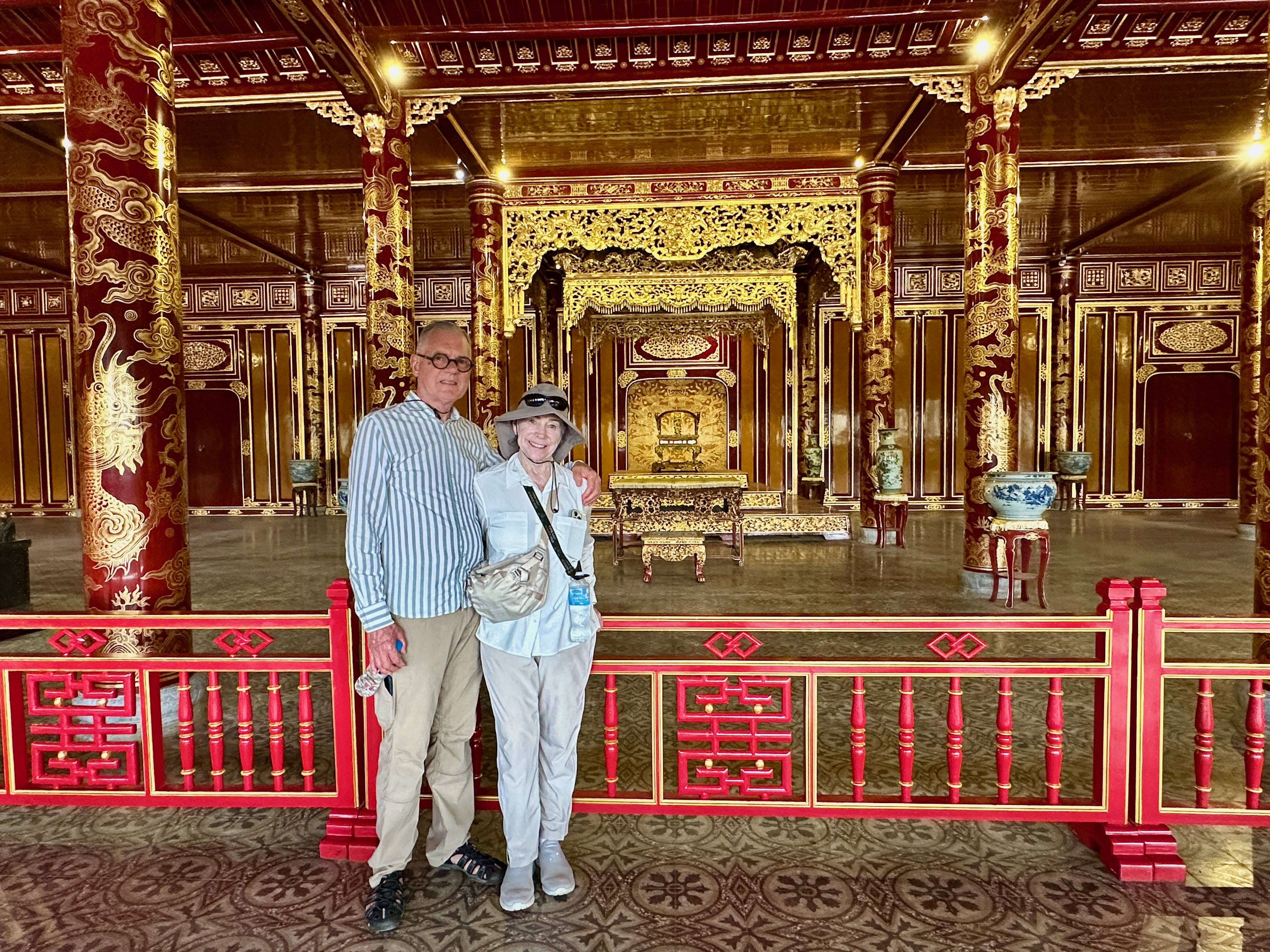
Here is a video of our drive over the Dragon Bridge in Danang.Beautiful coastal views as we drive up the mountain on our way to Hue. There is a 10K tunnel which makes the trip much faster but this is the scenic route.Our second stop on the road to Hue was Hai Van Gate which sits atop of Hai Van Pass marking the border between Danang and Hue.This site had been in ruins for years until an excavation in 2017 unearthed the original boundary of the Hai Van Gate relic of 1826, which was overlapped by 1960’s- built rock walls and tunnels erected by the French and US soldiers during the “French” and the “American” wars in Vietnam (this is how the Vietnamese people refer to the war). The complex was built in 1826 under the rule of King Minh Mang who ordered the construction of multiple defensive structures to protect the then imperial capital of Vietnam in Hue.More amazing sights of our long driveOn arrival in Hue our guide brought us to this amazing French restaurant, Les Jardins de la Carambole, where we enjoyed some fabulous non Vietnamese food that we were getting a bit tired of.Rack of lamb for SandyWaygu beef Tenderloin for Jim with a mushroom sauce.We were the only ones in the restaurant until a tour bus pulled up and emptied out a bunch of Italian tourists who were very loud. Fortunately we had finished our meal and were about to leave.Our home for the next three nights.Front of the hotel.Our Accommodations with Sandy’s new straw hat on bed that she bought in Thailand. It dressed up her outfits and allowed for no fuss hair do.Again quite luxurious.Nice lounging area which we never used. Sandy is the packing and unpacking guru and rule #1 is nothing is put in bureau drawers if we are there for only one or two nights as she feels it puts us at risk for forgetting things. We usually just keep our clothes in the suitcase or spread out on a couch or table. Sandy used packing cubes for this trip which worked out great.Balcony with view of The Perfume River on the far left. Also never sat out here.Sunset as viewed from our room.Because of the extreme heat that occurs later in the day we set out with our guide at 7 in the morning to explore the Citadel and the Imperial City. This sprawling complex, known as the Complex of Huế Monuments, encompasses the Citadel, the Forbidden Purple City, and numerous temples and pavilions. Established in 1802, it served as the political, cultural, and religious center of the Nguyen Empire.This is the outer wall of the CitadelA selfie with our guide Mr. Quoc.Standing on the wall looking down at the main entrance over the moat. We watched people arriving in beautiful traditional dress. The national dress for men and women is called ao tai, a silk tunic with pants. They are worn during special occasions such as Tet and the Lunar New Year celebration. 2025 is the year of the Wood Snake.Phung Tien Palace inside Hue Imperial Citadel was completely destroyed after many historical upheavals. Since 2017 the complex of the palaces have been gradually restored to preserve the remaining structures and revive their original shape and function.Many Vietnamese come to the palace in traditional garb and have professional photographers with them. The outfits are often rented for the day.Sandy lusted to buy one of these silk outfits and the conical hat and agonized the entire trip over purchasing one but in the end resisted as she thought it would never be worn again.👏And then there are the American tourists dressed in sun protection garb.You can see the damage from the war from canon and rifle blasts.The Royal Palace of Hue shown here, with its intricate dragon motifs and vibrant red and gold tones, is a classic example of Nguyen-era architecture, emphasizing harmony, symbolism, and imperial grandeur. The elaborate tiled roof, carved wooden doors, and stone balustrades reflect both Confucian ideals and Vietnamese craftsmanship. Though damaged during the wars of the 20th century, much of the citadel has been carefully restored, preserving its place as one of Vietnam’s most significant cultural landmarks.Beautiful renovated details.This hall served as the venue for the most important imperial rituals, including coronations, receptions for foreign dignitaries, and royal birthdays. Its richly lacquered red pillars adorned with gold dragons symbolize the emperor’s divine authority,The ornate throne, raised upon a marble platform beneath a golden canopy, served as the literal and symbolic seat of Nguyen power.Jim’s ceiling shot( he loves taking these). The intricate wooden ceiling panels feature classical Chinese calligraphy and motifs.This intricately cast bronze dragon is a powerful emblem of imperial authority and spiritual protection. In Vietnamese culture, the dragon (rồng) is not a fearsome beast but a revered symbol of wisdom, prosperity, and divine power.This was the gate where women could enter the temple. It was the most beautiful and very ornate with broken porcelain and sea shells embedded in the masonry.Ta DahThe Temples and gates just keep going on and on.This building housed a display featuring all 13 kings of the Nguyen dynasty. No pictures were allowed inside and our photographer was suffering heat stroke.It was so hot that Sandy was feeling physically ill and was ready to return to our room but after a short rest and hydration she got a second wind and continued. This was at 8:15 am. That is how intolerable the humidity was for her.🥵Residual shrapnel damage from the war.This building is the Royal Treasury/Long An Palace, now home to the Hue Museum of Royal AntiquitiesDragon handrails into the palace/museum.Elegant interior displays.While violins are not a traditional instrument associated with the Hue royal court, a unique porcelain violin was crafted by a Vietnamese artisan and violinist who played it before the Emperor of Japan in 2019. Our guide did not know the significance of what appeared to be a melting violin in the case. After the nearly aborted tour of the Citadel and Imperial City we now are going to visit another Pagoda.😡This Bonsai garden was worth the visit.This car is a relic, see below.A picture of the incident described above.It’s nice to be in the beauty of nature after all the manmade Temples and Palaces.And finally another Pagoda. This is the Thiên Mụ Pagoda (Pagoda of the Celestial Lady), one of the most iconic landmarks in Huế, Vietnam.A seven tiered pagoda.A guardian of the gate.
Short video of the boat we will board for the ride home.One of the bridges over the Perfume River that was bombed during the war.
Video of our boat ride home. Sandy made more unwanted purchases at the boat gift shop to support the family.Our room from the river. We returned to our room at 10am for a three hour mid-day chill.🥵Heading out again in the afternoon. Supposed to hear the nuns chanting today.After a half hour wait our guide surmised that they were taking the day off.🙂Since we couldn’t hear the nuns he then took us to another temple.🙄
A video to hear this guy chantThis is a teahouse at the tomb of Emperor Tu Duc. Unlike other tombs, this site was designed as a living space rather than a final resting place, blending elements of leisure, contemplation, and imperial grandeur. The Emperor enjoyed spending time here when he was alive.The Stele Pavilion. There is a massive stone tablet inside, on which the emperor’s biography is written. He had many wives but was childless due to smallpox which apparently rendered him either sterile or impotent.Last stop of the afternoon was this tiger arena where at one time elephants and tigers fought in mortal combat for the entertainment of the royal family and the elephants always triumphed.This is the tiger’s den. Jim bravely entered to check it out more closely.Our third outing of the day was a dinner at the home of Thao who is a relative and caretaker of the temple garden house/shrine of Princess Ngoc Son daughter of Emperor Dong Khan (1885-1889) and wife of Nguyen Huu Tien who was head of the Nguyen military. Upon the Princesses’s death he remarried and Thao is his greatgranddaughter from that marriage. For over 90 years the descendants have preserved the house. Our first course was a green papaya salad, prepared by her mother and served to us by a server. Unfortunately, her mother never came out of the kitchen, so we didn’t have the chance to meet her. Despite our guide having warned her about our small appetites, the meal included several courses. The beautifully arranged salad was thoroughly mixed before it was brought to the table.A key feature of the house is its fengshui design and garden with a lotus pond which symbolizes purity and prosperity and brings harmony to the home. Thao considers herself third generation. She lives there with her parents, a sister and nephew. So three generations of Royalty currently reside in the house now. Next day was check out time.Our guide and driver brought us to newly built Phu Baii Airport. We departed from here to Hanoi. And that’s a wrap for Hue.
Hue is definitely worth a visit as the Citadel and Imperial City are so impressive, especially considering the relatively recent war and battle in this city. We are so impressed with the resilience and friendliness of this country given what they have been through.
What an amazing experience….these blogs are wonderful…..thank goodness you are documenting all of this, as the temples, villages, narrow streets must all be a blur at some point!!!
Great seeing how Hue has recovered from the war.
Hue 1968 by Mark Bowden is an epic account of the battle for Hue.
So great that Jim and I avoided the war.
Really remarkable! You bring a freshness to this very old fascinating world. I am amazed that you maintain this freshness after so much traveling. You bring these different worlds to my very narrow world.
Amazing temples and such natural beauty. It’s good I wasn’t there to encourage Sandy to buy the conical hat and outfit! So glad that Jim is strong enough to hold up stalactitie!!!! I’ve enjoyed viewing these extrarordinary scenes without experiencing the heat and humidity. You are both amazing!


Leave a Reply